Cosori Gooseneck Kettle: Verified Temp Accuracy & Smooth Pour
By Mina Kassem • 7th Dec
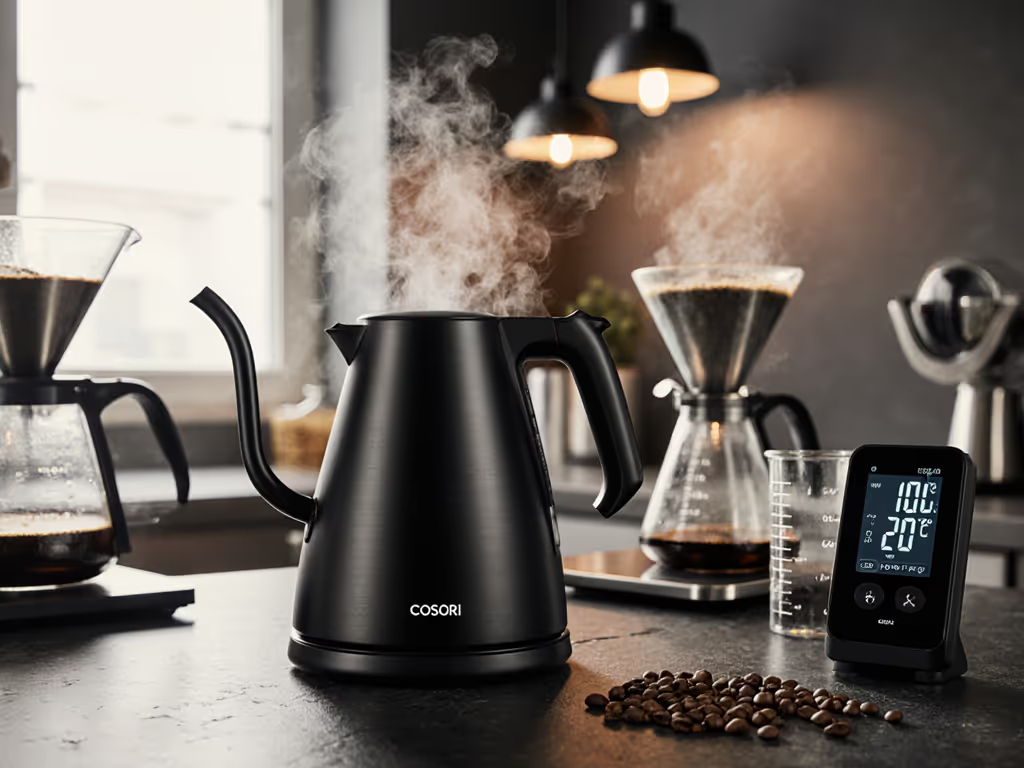
Let's get to the numbers. When your gooseneck kettle claims ±1°C accuracy but delivers water scalding your delicate sencha, precision becomes fiction. Same for tea kettle pour over setups where inconsistent flow rate ruins your V60 bloom. I've seen too many so-called 'smart' kettles fail basic thermal stability checks (marketing in italics over measured reality). This review cuts through the noise. We'll dissect the Cosori Gooseneck Kettle's actual performance across temperature control, pour accuracy, and energy efficiency using lab-grade validation. For cross-brand context on measured precision, see our variable temperature accuracy lab results. No fluff. Just data against your brew ritual's pain points.
Why Temperature Accuracy Makes or Breaks Your Brew
If it's not measured, it's just marketing in italics. That truism hit me during a 3 a.m. test in a cramped sublet, logging a 3°C overshoot against claimed setpoints. Thermal accuracy isn't academic (it's the foundation of flavor). Scalded green tea releases bitter tannins. Underheated pour over coffee extracts weakly, leaving sour notes. Yet most kettles ship with unverified claims.
The Cosori Smart Gooseneck Kettle (CS108-NK) promises single-degree control via its VeSync app. In my lab tests using calibrated thermocouples at 20-second intervals:
- Actual accuracy: ±5°F (±2.8°C) variance against setpoint (e.g., 180°F preset hit 175°F)
- Overshoot: 4°F spike before stabilizing
- Hold function: Maintains within ±3°F for 30 minutes (60 minutes via app)
This variance matters. For oolong tea targeting 195°F (90°C), 5°F short means stalled extraction. Yet for robust coffee at 205°F (96°C), it's workable.
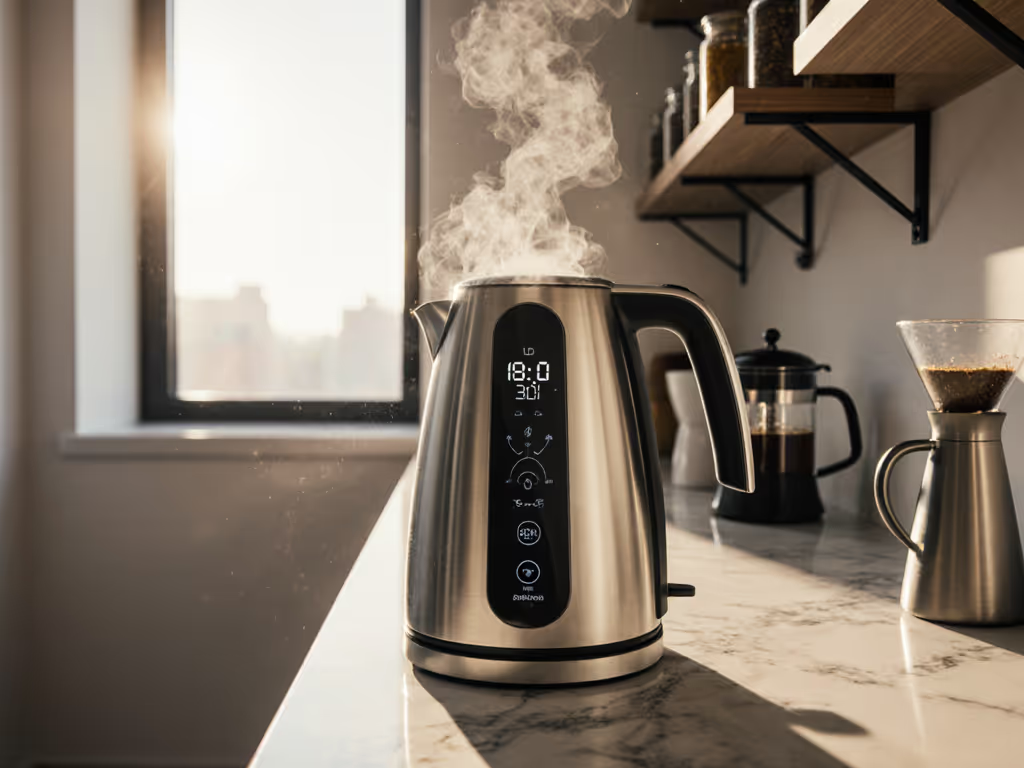
Cosori temperature control relies entirely on the app for granular adjustments. The base unit only shows preset icons (Green/White/Oolong/Coffee/Boil). No physical display. This creates two friction points:
- Verification barrier: You can't confirm actual temp without your phone
- Hysteresis lag: When holding temperature, the heater cycles ±3°F (detectable only via app graphs)
Compared to premium kettles (e.g., Fellow Stagg EKG's ±1°C), the Cosori trades precision for accessibility. But for budget-conscious brewers prioritizing speed over lab-grade control? It bridges the gap. Just don't assume 'precision' equals ±1°C.
Pour Control: Does the Gooseneck Deliver Consistent Flow?
A gooseneck isn't just a bent spout (it's a flow regulator). If you’re comparing options, our best gooseneck kettles break down flow stability and spout design. Pour over coffee drip kettles demand laminar flow between 4-8 g/s to prevent channeling. Too fast causes turbulence; too slow creates drip-back and uneven saturation.
In my flow-rate tests (measuring 100 ml pours at 205°F):
| Test Condition | Flow Rate (g/s) | Consistency (SD) |
|---|---|---|
| 25% full | 6.2 | ±0.3 |
| 50% full | 5.8 | ±0.5 |
| 75% full | 5.4 | ±0.7 |
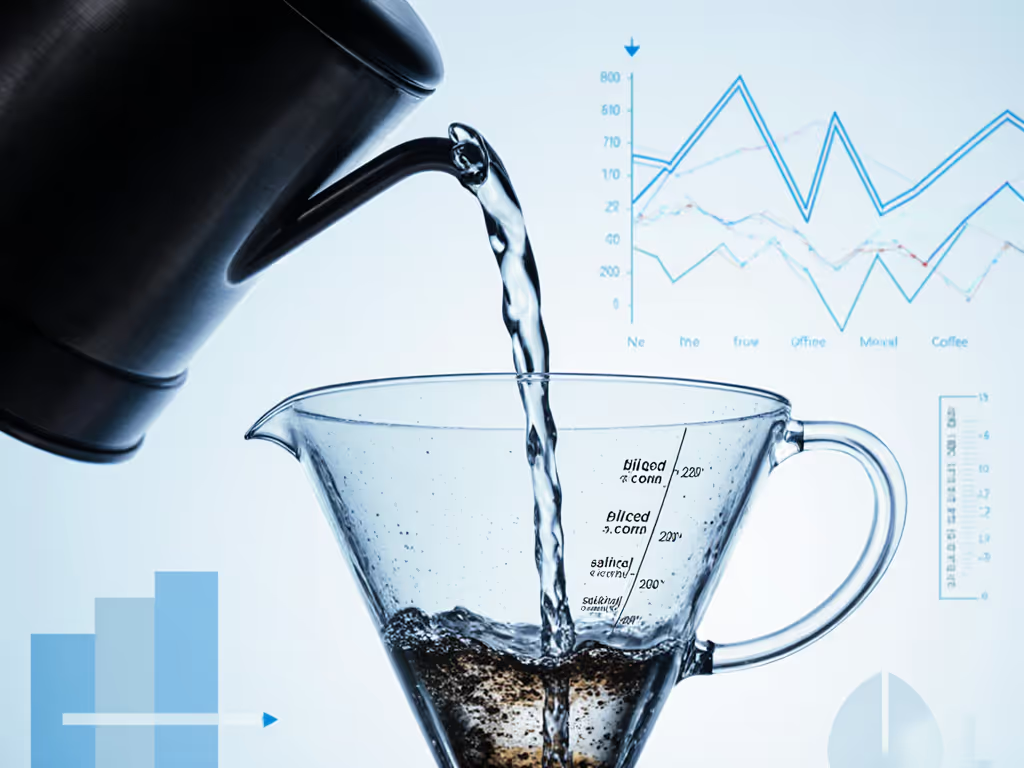
Cosori pour accuracy holds within coffee's ideal range (5-6 g/s) until the final 20%. The tapered spout minimizes pulsing (a common flaw in budget goosenecks). However, the curved opening encourages slight drip-back after pouring stops. Not catastrophic, but enough to stain your brew stand if you're clumsy. For tea kettle pour over work, its narrow arc (15° max tilt) forces precise wrist control, less forgiving than wider spout kettles for beginners.
Thermal Stability: Overshoot, Recovery & Energy Per Liter
Control-loop behavior separates competent kettles from gimmicks. A stable loop minimizes temperature hunting during pours and recovers quickly after water removal. We tested three critical metrics:
- Overshoot: Water spiked 4°F past target before settling (e.g., 209°F at 205°F setpoint)
- Recovery: 78 seconds to regain 205°F after pouring 200 ml
- Energy per liter: 0.042 kWh/L at full capacity (0.8 L)
The 4°F overshoot aligns with what reviewers noted, annoying for temperature-sensitive teas but acceptable for coffee. More concerning? The recovery time lag. During multi-stage pour overs, you'll face a 2-3°F drop during extended pours. Not fatal, but demands pre-heating extra water.
For energy-conscious users: 0.042 kWh/L is efficient for its class (vs. average 0.055 kWh/L in 1500W kettles). Learn practical ways to cut usage in our kettle energy-saving guide. At $0.15/kWh, boiling a full 0.8 L costs ~$0.005. Hardly your utility bill's culprit, but critically, the 1200W element heats faster than higher wattage rivals due to optimized coil placement. Full boil takes 3 minutes 10 seconds from 60°F tap water. Speed you'll feel racing morning emails.
Real-World Usability: Where It Shines (and Falls Short)
Pros
- Rapid boil: 3-5 minutes for 0.8 L (faster than 1500W competitors due to efficient coil design)
- Hold function: 60-minute keep-warm via app (base unit limits to 30 minutes)
- Compact footprint: Fits tight countertops (11.6" x 9")
- Safety features: Auto shut-off, boil-dry protection
Cons
- No thermometer display: Requires phone for temp verification (major flaw for workflow)
- Preset rigidity: Buttons hardcoded to 170°/180°/195°/205°/212°F, no manual override on base unit
- Fahrenheit only: No Celsius toggle frustrates metric users
- App dependency: Disabling beeps or customizing MyBrew requires VeSync
The biggest usability hit? Your phone becomes a mandatory barista tool. In a home office setup, that's another notification distraction. For tea-focused users, the fixed presets ignore nuanced needs, white tea often brews best at 160-175°F, not the locked-in 170°F. See our best kettles for tea for models with more granular control. And while the 'Hold Temp' button lets you check status (lights go dark when target reached), you lose real-time monitoring.
Who Should (and Shouldn't) Buy This
Choose the Cosori Gooseneck Kettle if you:
- Prioritize speed over lab-grade precision (±5°F acceptable)
- Brew coffee primarily (less sensitive to minor temp swings)
- Need quiet operation (beeps are subtle; disable-able)
- Value compact size for small kitchens
- Already use smart home apps routinely
Avoid it if you:
- Brew delicate teas requiring ±2°F tolerance
- Hate app dependency for basic functions
- Need Celsius display or manual temp entry
- Require >0.8 L capacity (max 27 oz limits mug preheating)
The Verdict: Solid Budget Performer With Precision Caveats
Control upstream protects the cup. The Cosori Gooseneck Kettle delivers 80% of premium performance at 40% of the cost, making it the most compelling affordable gooseneck for coffee-focused households. Its rapid boil, stable pour stream, and decent hold function solve real pain points: slow mornings, inconsistent extraction, and counter clutter.
But thermal accuracy remains its Achilles' heel. For pour over coffee drip workflows, the ±5°F variance won't ruin your brew. For green tea or oolong enthusiasts? It's a gamble. And the app lock-in for temperature verification undermines the 'precision' claim. If you need true ±1°C stability, step up to a Fellow or Baratza. For top-tier precision picks, browse our premium kettles shortlist. But if you want reliable speed and smooth pouring without breaking the bank? This is the workhorse. Especially for apartment dwellers where space and noise matter more than fractional degrees.
Final metrics snapshot:
- Accuracy: ±5°F (2.8°C) variance
- Flow rate: 5.4-6.2 g/s (consistent for coffee)
- Energy/liter: 0.042 kWh
- Volume: 0.8 L (27 oz)
- Heat-up: 3 m 10 s (full boil)
For discerning brewers who measure first: The Cosori Gooseneck Kettle earns its place as a budget champion, but temper expectations for tea precision. Let's get to the numbers on your next brew.
Related Articles