Visual Temperature Indicators: Which Kettle Display Works Best?
By Ava Osei • 6th May
When you're trying to brew a cup of green tea that tastes bright instead of bitter, or pull an espresso shot with body instead of sour edges, the numbers matter. Visual temperature indicator comparison and kettle temperature display effectiveness are questions that rarely get the rigorous attention they deserve. Most brewers assume a "boil" button and hope for the best, but if you've ever scalded delicate leaves or watched temperature swings undo a good pour-over, you know how much display quality shapes flavor, cup after cup.
This guide walks through the main types of visual cues kettles offer, how they actually perform, and which one fits your brew style and space. I'm not here to shame anyone's gear or pretend perfect temperature is for experts alone. Precision is a habit, not an advanced setting, and the right display makes building that habit nearly effortless.
Why Display Type Matters More Than You Think
The display on your kettle isn't a luxury. It's the difference between knowing your water hit 80°C for fragile green tea and hoping it did. When you rely on guesswork, you can't repeat a good cup, and you can't diagnose why last week's brew tasted better than today's.
I'll never forget a friend who swore green tea was bitter no matter the brand. We set a variable-temperature kettle to 80°C, poured gently, and timed the steep at three minutes. Their face at the first sip said everything. The tea wasn't bitter, the ritual had been broken by heat all along. Precision didn't kill the moment; it saved it, cup after cup, like clockwork. That's what a good display does: it transforms uncertainty into confidence.
Frequently Asked Questions: Kettle Displays Explained
What Types of Visual Temperature Indicators Do Kettles Use?
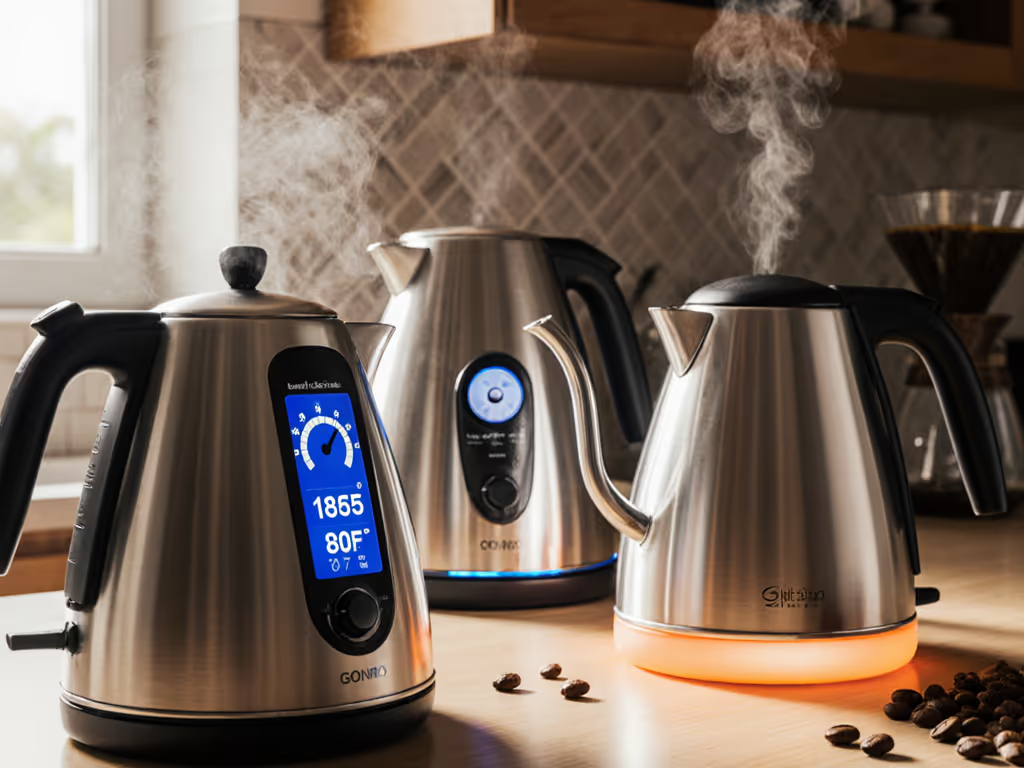
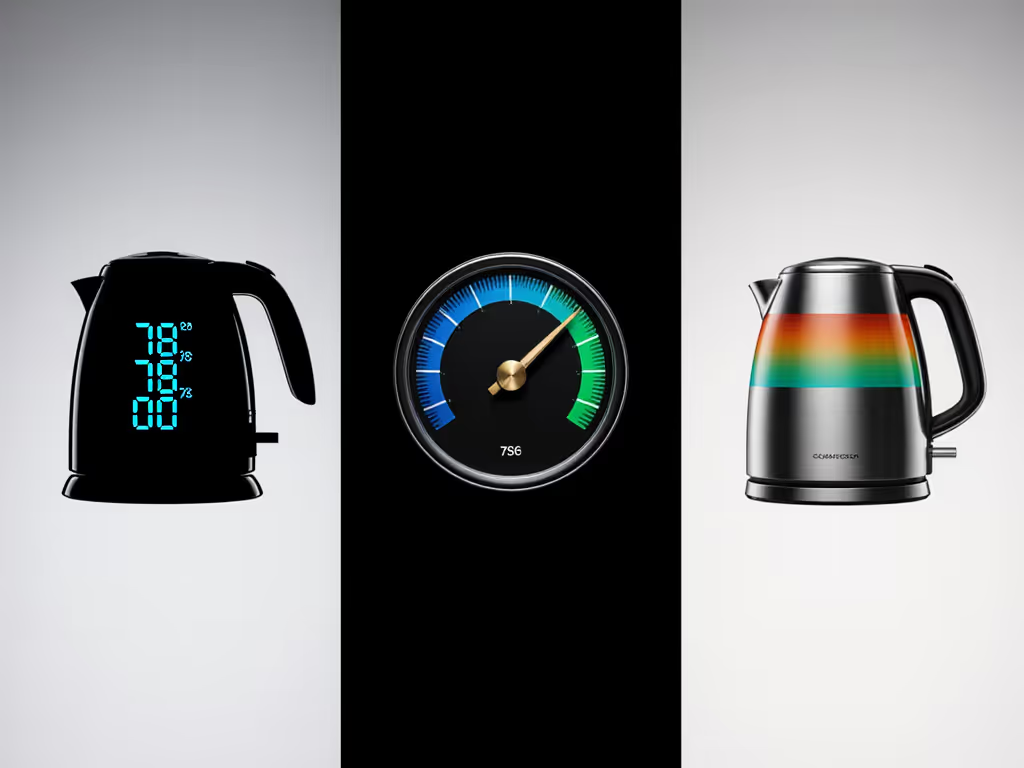
There are three primary approaches: LED temperature indicators, traditional dial or gauge systems, and color-change kettle technology. Each has distinct strengths and trade-offs.
LED displays are the most common in modern kettles. These are digital screens (often backlit) that show a number: 75°C, 85°C, 95°C. Some kettles display the current water temperature in real time; others show your target setpoint. A few advanced models do both, with a setpoint number and a live "current temp" bar or graph that narrows as water stabilizes. This is the clearest visual approach for someone building a repeatability routine.
Color-change indicators rely on thermochromic materials (inks or strips that shift color as heat rises). A simple version might show green at 60°C, yellow at 70°C, and red at 95°C. These are intuitive and require no electricity, but they sacrifice precision. You get a range, not a number, and you can't set a specific target like 75°C for oolong.
Dial and gauge systems use a needle or pointer moving across a semicircular scale, usually marked with temperature zones or single-degree marks. These feel analog and tactile, but reading them requires you to stop and look directly at the kettle. In a rush, you might misread by 5°C, enough to ruin a cup of delicate oolong.
There's also the no-display option: kettles that beep when water reaches a preset temperature (often just 100°C). These rely on sound alone, offering speed but zero flexibility. Useful if you only brew black coffee or instant oatmeal, but limiting if you want to branch out. For a deeper breakdown, see our variable temperature vs basic kettles guide.
How Accurate Are Different Display Types, Really?
This is where the data gets honest.
LED displays on consumer kettles typically have a temperature display accuracy of ±2-5°C from the setpoint, depending on the model and whether the sensor is in the heating element (faster response, less stable) or in the water body (slower response, more stable). Higher-end variable-temperature kettles can hit ±1-2°C, though the price jump is real. See our lab-tested variable temperature kettles for verified accuracy data. The key question: does the kettle show you overshoot? A display that freezes at your target while water is actually 2°C higher is being dishonest.
Color-change indicators introduce about ±3-8°C of uncertainty, since you're matching a hue to a printed scale, and lighting affects perception. Two people reading the same kettle under fluorescent office light versus morning sunlight might see slightly different "zones." For someone building a routine, this variability compounds: yesterday at "yellow" might be 72°C; today it's 68°C.
Dial gauges fall somewhere between: if the scale is wide and clearly marked, you might read 80°C when it's actually 77°C, roughly ±2-3°C. If the scale is cramped or the needle is thick, the margin widens. You're also guessing every single use; there's no memory.
The honest truth? No kettle display is perfect. But what matters is repeatability. If your kettle reads 80°C consistently, and you brew at "80°C" every time, muscle memory builds. You learn what that cup tastes like. Small changes, big flavor, and consistency comes first.
Which Display Type Works Best for Different Brew Styles?
Here's where the rubber meets the road.
Pour-over coffee and oolong brewing need precision. For pour-over specifics, compare our best gooseneck kettles tested for precise flow and control. These techniques benefit from tight control: 195-205°F (90-96°C) for medium roast, 75-85°C for oolong. An LED temperature indicator is your friend here. You set the target, you see the number lock in, and you pour once it holds steady. No squinting, no guessing. You build a ritual: set it, wait for the tone, pour. Same thing tomorrow.
Green and white tea are the most forgiving reason to upgrade your kettle display. Green tea burns at 85°C but thrives at 70-75°C. If your kettle has no display, you're boiling to 100°C and guessing when it cooled enough. A simple LED display or color-change indicator gives you the confidence to move the water into your cup at the right moment. That's the whole game.
French press and full-immersion brewing are less temperature-sensitive (somewhere in the 195-205°F range works fine), so a beep-on-boil kettle suffices, or even just a visual cue ("steam is rolling vigorously, it's ready"). But if you're experimenting with slightly cooler water to reduce over-extraction or sourness, an LED display helps you document what worked and repeat it.
Instant oatmeal, formula, or baby food prep need 60-70°C exactly. A color-change indicator or LED that marks these zones is invaluable for safety and consistency. Dial gauges and no-display kettles leave you guessing, which is unacceptable for infant feeding. One parent told me they used an LED kettle to prep bottles every morning at exactly 65°C for three months, same temperature, same ritual, no thinking.
Office or shared-kitchen use often means quiet operation and simplicity. An LED display with presets (button for "70°C," button for "95°C") lets multiple people brew their preferred drinks without fuss. No need to shout over the kettle's boil; no need to explain the dial. Repeatability for everyone.
LED vs. Color-Change: Which Is Truly More Effective?
Effectiveness depends on your goal and living context.
LEDs win on accuracy and repeatability. You see a number, you hit a number, you repeat. Over 30 brews, that LED display trains your hand and your palate to expect the same thing. There's no ambiguity, no squinting at color under fluorescent office lights or in dim morning kitchens. If you live in a space with inconsistent natural light (a basement studio, north-facing apartment, or office with overhead panels), an LED eliminates variables that color-change systems can't.
LEDs also offer memory and presets. You set 75°C once, the kettle remembers it, and next morning you hit one button. That's a habit made effortless. Most color-change kettles can't do that; you have to guess or count the color bands every single time.
Color-change indicators win on simplicity and cost. No battery, no circuit board, no settings menu to fumble with when you're half-asleep. If you brew the same thing every day (black coffee or tea, always 95°C), a color-change kettle works fine and costs less. The ritual of watching the colors shift is also genuinely pleasant, it is a visual cue that water is ready, like a traffic light for your kettle.
The trade-off: color-change kettles suit people who've already figured out their brew style and don't expect to experiment. LED kettles suit people building habits or juggling multiple brewing methods.
How Do I Know If a Kettle Display Is Actually Telling Me the Truth?
Skepticism is smart. Manufacturers exaggerate; marketing loves claims like "precise to 0.1°C" (rarely true, and almost never relevant).
First checkpoint: independent reviews. Look for write-ups that mention actual measurements, places where someone used a calibrated thermometer to test the kettle's reading against real water temperature. If a review says, "I set it to 85°C and measured 84°C and 86°C across five pours," that's honest data.
Second checkpoint: sensor placement. Ask or look up where the sensor sits. If it's in the heating element, expect ±3-5°C variation because the element gets hotter than the bulk water. If it's in a well submerged in the water body, expect better stability (±1-2°C). This detail is rarely advertised but often findable in user manuals or tech specs.
Third checkpoint: hysteresis and overshoot behavior. Real kettles overshoot, they heat past the target before cutting the element, then drop a few degrees. A good display shows you this happening in real time. A display that ignores overshoot and just says "85°C" when the water is actually 87°C is lying by omission. Some kettles display a live temperature bar that shrinks and stabilizes; that's a sign the manufacturer isn't hiding the truth.
Fourth checkpoint: warranty and return policy. If a company stands behind ±2°C accuracy for two years, that's more reassuring than bold claims with a 30-day return window.
Does Better Temperature Accuracy Translate to Better Brew Quality?
Yes, but with a ceiling.
Once you hit ±2°C accuracy, the difference in cup quality stops being huge. The jump from "I boil it" (±15°C guessing territory) to "I use an LED at 80°C" (±2°C) is massive. That green tea goes from scalded and bitter to bright and delicate.
The jump from "±2°C LED" to "±0.5°C fancy kettle" is real but incremental. You might notice it over 20 brews; casual drinkers won't.
Where display accuracy really shines is repeatability. When you brew the same thing the same way, you taste the plateau: you know whether a sour shot is stale beans or whether today you forgot to let the water cool. You stop chasing ghosts. That's the hidden value of a good display, not perfection, but reliable consistency.
What's the Smartest Way to Choose a Display for My Situation?
Here's a simple decision path:
Are you brewing one or two drinks, always the same way? (e.g., black coffee every morning, black tea every evening) → A color-change kettle works. Cost is low, interface is intuitive, and you've learned the visual cues.
Do you enjoy experimenting with brew styles or have a household with different preferences? (e.g., you do pour-over, your partner drinks green tea, your kid drinks instant cocoa) → An LED kettle with presets is worth the investment. Set and forget. Habit-building becomes automatic.
Do you brew temperature-sensitive tea regularly? (oolong, green, white, herbal blends with precise targets) → LED is non-negotiable. Dial gauges and guessing introduce too much variance. 75°C oolong tastes completely different from 80°C oolong.
Are you in a tight space, an early riser, or office-focused? (studio apartment, quiet mornings matter, shared kitchen) → Prioritize an LED with a keep-warm feature that holds temperature without cycling the element every 10 seconds. Less noise, less water loss, less wasted energy.
Are you on a tight budget or a minimalist? → Start with a color-change kettle or a manual dial. Upgrade to LED only once you've confirmed your brew style and that you'll use the presets. No shame in the staircase approach.
Do you have hard water? (Likely if you live in much of North America or Europe.) → An LED display won't be fouled by limescale buildup, but make sure the kettle's sensor is accessible for cleaning. If you’re in a hard-water region, follow our hard water descaling guide to keep sensors accurate. Dial gauges and color-change strips can fail if mineral deposits coat them.
Wrapping It Up: Your Next Step
The right visual brewing cues remove friction from your routine. You don't need laboratory gear or a $200 kettle. You need a display that's easy to read, consistently accurate (±2°C is plenty), and memorable, so you can set it and brew the same way tomorrow.
I've watched people transform their tea experience by upgrading from "hope and boil" to an LED kettle set at 75°C. No fancy technique. Just precision as a habit: set it once, trust it, repeat it. That's when ritual stops being frustrating and becomes satisfying.
Precision is a habit, not an advanced setting. A good display makes that habit simple.
Further Exploration
Ready to narrow down your next kettle? Here's what to do next:
- Review independent tests: Check write-ups that cite actual temperature measurements, not just "heats fast" or "looks sleek." Look for mentions of overshoot and stabilization time.
- Identify your primary brew style: Which tea, coffee method, or specialty drink do you make most? Build your kettle choice around that one use. A 75°C preset is worth its weight if you're a green tea person.
- Test before buying, if possible: Visit a kitchen showroom or borrow a friend's kettle. Does the display light up? Is it readable in your home's lighting? Can you physically reach the buttons without fumbling?
- Invest in repeatability, not bells: Choose a kettle that makes you want to use it the same way every morning. That consistency compounds over weeks into noticeably better cups.
Small changes, big flavor. Start with the display that fits your life today.
Related Articles